“It is better to lead from behind and to put others in front, especially when you celebrate victory when nice things occur. You take the front line when there is danger. Then people will appreciate your leadership.”
–Nelson Mandela.
WHAT DO YOU MEAN BY LEADERSHIP ?
According to Dr. Myles Munroe, the CEO of Third International World Leaders Association and author of the book ‘ The Spirit of Leadership ’, “Leadership is the capacity to influence others through inspiration motivated by passion, generated by vision, produced by a conviction, ignited by a purpose.” (Daskal, 2016). The leadership in an business organization can be a process of motivating and directing the employees and colleagues with a definite strategy to meet the goals of the organization (Ward, 2020). Leadership does not have to do anything with any level of position in an hierarchy or seniority of an organization rather is aspired by the traits and attributes of a Leader and the degree of inspiration achieved by its followers (Kruse, 2013).
TRADITIONAL APPROACH OF LEADERSHIP
Kurt Lewin, called as the ‘ Father of Social Psychology ’ in the era of 1930’s gave a ground-breaking work by identifying three behavioural types of leadership styles classified as the traditional approaches if leadership (Carlin, 2019) :
| AUTOCRATIC LEADERSHIP | Lewin explains the autocratic style of leadership as a management style wherein higher authority has the power to control all the decisions and accepts very little input from its sub-ordinates. The decisions are highly based on the leader’s beliefs and eliminated from its followers suggestions/advices. Autocratic leadership is only an effective form in such organizations where quick decisive making process is enabled for any nature of work performed within whereas the leader is the sole responsible authority of the outcome of the decision implemented. Possibilities of damaging the structure as well as profit making body of organization in a long run as it resembles that with a dictator type of leadership. Source : (TheEconomicTimes, 2020). |
| DEMOCRATIC LEADERSHIP | The following type is also identified as the participative leadership where the subordinates are equally involved for the process of decision making. Considered as greater effective method than autocratic leadership due to enough participation of all the authorities reporting benefital in achieving the business goals within time frame. The framework enables employees come together, enhance the communication & sharing of ideas, reaching a consensus for the best approach ahead. Source : (Luenendonk, 2016). |
| LAISSEZ-FAIRE LEADERSHIP | The term Laissez-Faire is a French term meaning ‘ leave alone‘. As the term say, the highlighting feature remains the fact of the leader staying out of an individual goal and allowing the subordinates to lead a specific goal. Influencing for decision making by the leaders is absent whereas the essence still remains to ensure the group to be self in charge for outlining the strategical objectives and persuading the conditions for recognizing the goals. Considered as the current emerging form of leadership styles among many organizations. Source : (Belyh, 2017). |
CONTEMPORARY APPROACH OF LEADERSHIP :
With the evolution of history and business, mankind has provided evolving great new leaders with their emerging leadership styles over crude centuries of time.
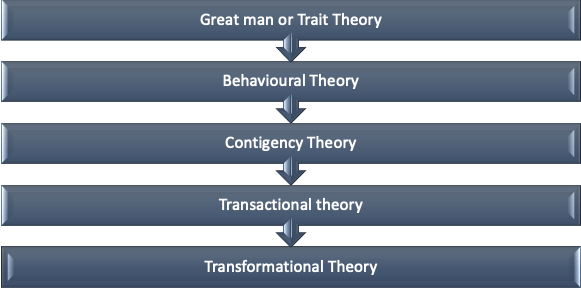
Mid 1800’s to 1940’s was recognized as the ‘ Trait ’ era when Scottish philosopher “ Thomas Carlyle ” gave the ‘ Great Man ’ theory also called Trait theory which included traits such as motivation, ambition, self-confidence, integrity, flexibility, intelligence, etc. asserting that leaders are born and not made. The ‘Behavioural Theories’ emerged in 1940’s existing for two decades. The theory promoted the fact that leadership can also be learnt following trends of weather leaders were concerned with the subordinates well-being or the work done. The ‘Contingency Theory’ followed the next two decades Upto 1980’s where ‘Hersey & Blanchard’ developed the Situational Leadership Model used as a base to select the type of leadership for implementation. Later, emerged the New Leadership Era. (Mac, 2015).
TRANSACTIONAL LEADERSHIP

The market during 1980’s got tightened arising a new form of leadership theory.
Transactional leadership also named managerial leadership primarily focusses on initial supervision, organization and lastly assessing the perfomancial background of the groups. The leader in a systematic and structural manner here expects its group to be compliant and rewards and appraises the one with best performance.
Key identified traits of the leader can be :
- Extrinsic motivation
- Practicality
- Resistant to change
- Discourage independent thinking
- Rewards performance
- Constrained thinking
- Passive & directive
- Emphasis on corporate culture and self-interest.
Source: (Volhein, 2012)
TRANSFORMATIONAL LEADERSHIP
The approach for the transformational leadership style was first held up in 1978 by ‘James Burns’ introducing the concept as a process where leaders with their charisma & followers are mutually responsible for each other’s improvement. Following in 1985, ‘Bernard Bass’ argued with the same theory in a different perspective (Mac, 2015).
Basically, Transformational Leadership Style exists where leaders continuously encourage, inspire and motivate its followers for innovation and change helping them to cultivate a better organization tomorrow. This emerging platform provides employees a free room to be more creative, look for the future and find answers to the problems and performed through mentorship and training (White, 2018).
By the past 10 years, researchers are very keen observing transformational leadership style as the most effective leadership strategy of implementation within both public as well as the private sector industries (Hassan & Hatmaker, 2014).
Bernard Bass gave some hallmarks of a transformational leader which sets them apart from the other styles of leadership.
- A transformational leader always encourages and motivates his team for the positive development and mindset of its employees performing any goals.
- The leader exemplifies the moral standards in the company and always fosters an ethical behaviour approach and work environment with clear set of values, priorities and standards.
- The leader possesses a positive attitude towards the work with the self-interest mindset working for a common good.
- The leader withstands on authenticity, cooperation and implements an open communication grounds.
- Coaching and mentoring are always provided to the employees on regular basis with new suggestions and ideas always welcomed Inspite of the ownership for the tasks.
Source : (White, 2018).
Therefore, the leader accomplishes his style of transformational leadership in any business organization by enabling a strong sense of corporate culture , ownership over employees and allowing independence to the employees in their workplace in the decision making process (White, 2018).
CHALLENGES FACED BY LEADERS OF 21st CENTURY
21st century world is considered to be a world of disruptive digital business models, highly augmented workforces and flat organization structures where the leaders experiences challenges from its company to buckle up and direct the path ahead. It is also analysed that many organizations still promotes traditional approach over the contemporary with the identical leadership capabilities as decades ago. This is believed to become an intersection of the traditional approach with new styles creating a crossroad for the company focussing on both ways (Volini, 2019).
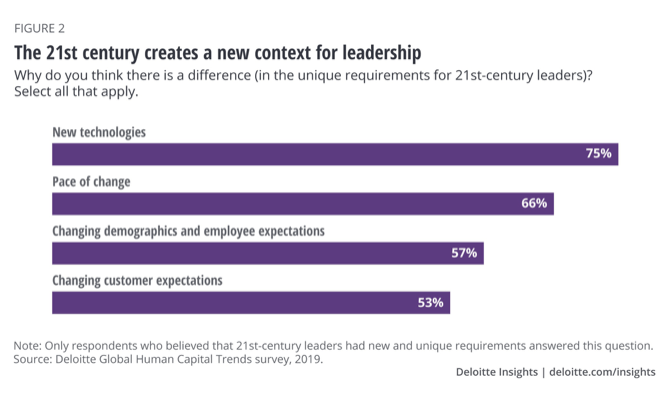
Above, represents the statistics by the 21st century leaders who believes evolutionary approach of leadership styles as a bloom over the traditional approach and identifies the practices and competencies developing the leadership styles and adding value to them (Schwartz, 2019).
Therefore, developed leaders with new competencies in their leadership approach brings new challenges evolved out. The leadership styles are equally paramount for an organization as equal as its culture, structure and managerial processes and hence gaps are mandatory to be identified and filled:
- Transparency being the most valuable currency for a company, enables competitive disadvantage if lacking. It engenders trust & respect among employees–owners.
- Internal collaboration eliminates loss making decisions and enables focussing on narrow towers of the responsibility and work together.
- Performance management measures the success of the individual leader to shape the behaviour in the 21st century world.
Source : (Durme,2019)

BRIEF ON LEADERSHIP STYLES APPROACH BY JEFF BEZOS
‘Jeff Bezos’, CEO, founder and the president of the Amazon company and the World’s Richest Person can be considered as an example of one of the greatest leader in the modern era (Forbes, 2019).
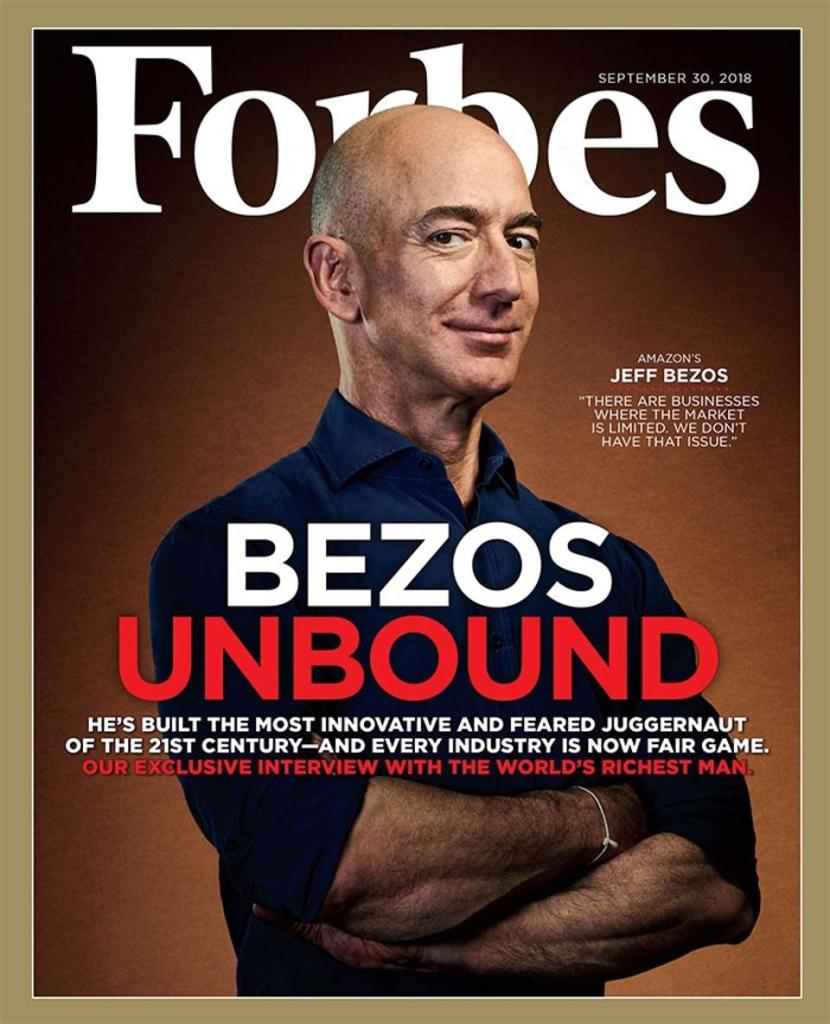
The 21st century gave the world some very unconditional leaders with their unique style of leadership and beliefs. Inspite of all, Bezos is considered as an unconventional and unique leader with traditional beliefs of leadership style. Bezos possesses Autocratic style of leadership and he monitors everything by his own. His strategies are unique and unpredictable but profit making. His vision regarding leadership is charismatic and sets the direction of his business by himself (Sattar, 2018).
The leadership qualities and the skills observed in Jeff Bezos for all his success are recognized as below:
- Have perseverance and resilience.
- Experimenting nature.
- Inventor of the company.
- Accepting new & unique experiences.
- Focus on the process, forget failure.
- Building culture right for the company.
- Strategical base that won’t change.
- Customer satisfaction always prioritized.
Source: (Sattar, 2018)
CONCLUSION
To the word of end, leadership styles no matter traditional or contemporary, has always impacted effectively over every organizations by its leaders and left the footprints of trust, motivation, empathy, commitment and devotion. The evolution of leadership styles over the centuries gave the world a theory of immense traits and qualities of different leaders inspiring their followers with the words of wisdom. The new approaches of the leadership styles will never end as the sense of ability by the leaders to persuade its followers will always drive up with new approaches. Hence, it can be evaluated with the fact that no leadership styles are incorrect, they are just a matter of difference by the leader performing and degree of acceptance by its followers.
REFERENCES
BusinessThinkingInstitute, 2017. BUSINESS IS AN OPPORTUNITY TO BE A LEADER. [Online]
Available at: https://www.businessthinking.com/content/business-opportunity-be-leader
[Accessed April 2020].
Daskal, L., 2016. 100 Answers to the Question: What Is Leadership?. [Online]
Available at: https://www.inc.com/lolly-daskal/100-answers-to-the-question-what-is-leadership.html
[Accessed April 2020].
Ward, S., 2020. The Definition of Leadership. [Online]
Available at: https://www.thebalancesmb.com/leadership-definition-2948275
[Accessed April 2020].
Kruse, K., 2013. What Is Leadership?. [Online]
Available at: https://www.forbes.com/sites/kevinkruse/2013/04/09/what-is-leadership/#43a0fbba5b90
[Accessed April 2020].
Carlin, D., 2019. Democratic, Authoritarian, Laissez-Faire: What Type Of Leader Are You?. [Online]
Available at: https://www.forbes.com/sites/davidcarlin/2019/10/18/democratic-authoritarian-laissez-faire-what-type-of-leader-are-you/#6a9fd0b12a6b
[Accessed April 2020].
TheEconomicTimes, 2020. Definition of ‘Autocratic Leadership’. Human Resources, January.
Luenendonk, M., 2016. Democratic Leadership Guide: Definition, Qualities, Pros & Cons, Examples. [Online]
Available at: https://www.cleverism.com/democratic-leadership-guide/
[Accessed April 2020].
Belyh, A., 2017. Laissez Faire Leadership Guide: Definition, Qualities, Pros & Cons, Examples. [Online]
Available at: https://www.cleverism.com/laissez-faire-leadership-guide/
[Accessed April 2020].
Mac, R., 2015. The Evolution of Leadership. [Online]
Available at: https://medium.com/skeptikai/the-evolution-of-leadership-51b6cae3ee0
[Accessed April 2020].
Volhein, L., 2012. 10 Transactional Leadership Characteristics. [Online]
Available at: https://yscouts.com/10-transactional-leadership-characteristics/
[Accessed April 2020].
White, S. K., 2018. What is transformational leadership? A model for motivating innovation. [Online]
Available at: https://www.cio.com/article/3257184/what-is-transformational-leadership-a-model-for-motivating-innovation.html
[Accessed April 2020].
Volini, E., 2019. Leadership for the 21st century: The intersection of the traditional and the new. [Online]
Available at: https://www2.deloitte.com/us/en/insights/focus/human-capital-trends/2019/21st-century-leadership-challenges-and-development.html
[Accessed April 2020].
Sattar, S. B., 2018. Leadership qualities, skills and style of Jeff Bezos. [Online]
Available at: https://www.thestrategywatch.com/leadership-qualities-skills-style-jeff-bezos/
[Accessed April 2020].